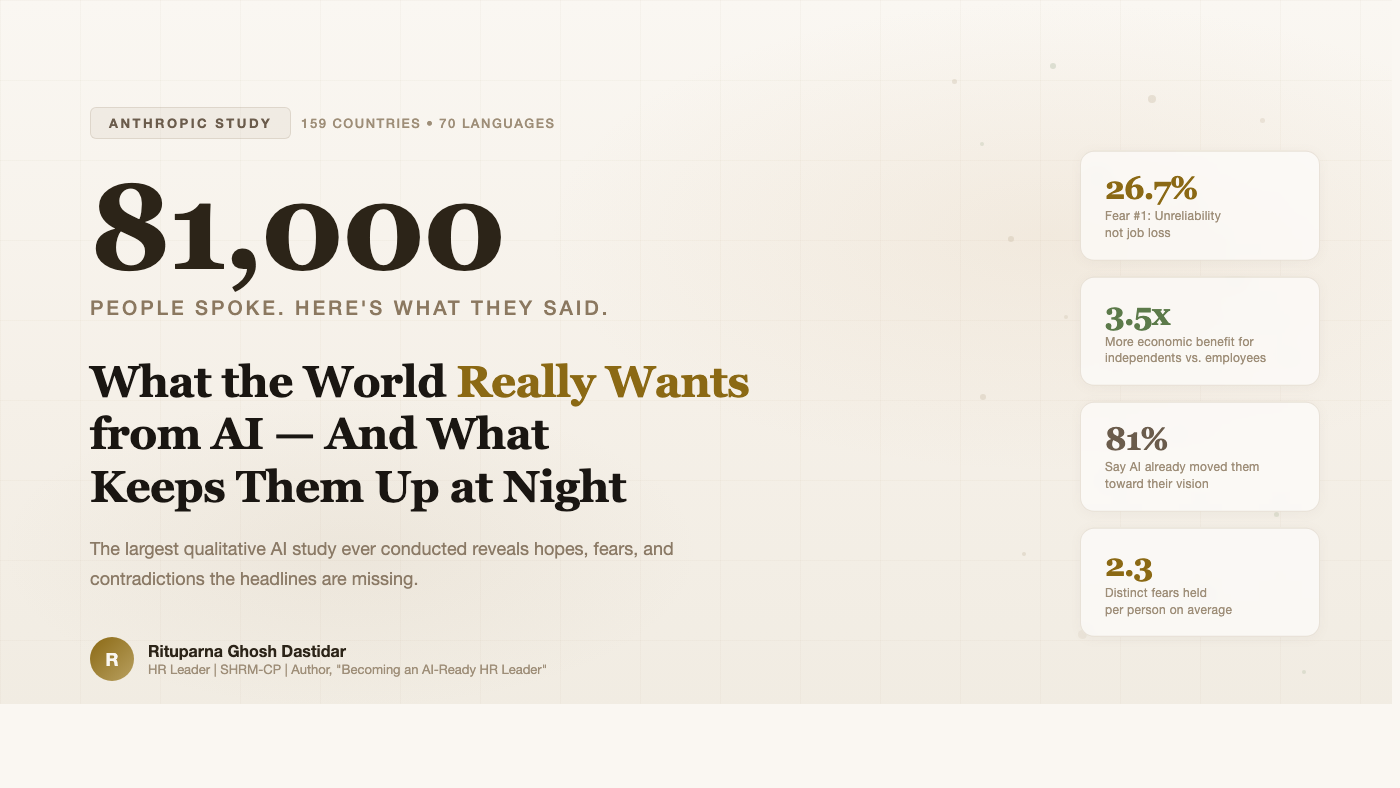
Last week, Anthropic released the largest qualitative AI study ever conducted — 80,508 people across 159 countries, in 70 languages, sharing what they actually want from AI, where it's delivering, and what terrifies them.
As someone who has spent 7+ years in HR and is currently writing a book on becoming an AI-ready HR leader, I didn't just read this study. I sat with it. Because this isn't a tech report — it's a mirror held up to the modern workforce.
And what it reflects back should matter to every professional, regardless of your role.
Here's what you need to know — in 5 minutes.
The Big Picture: What Do 81,000 People Actually Want from AI?
Forget the robot-apocalypse narrative. Here's what real people said:
- 18.8% Professional Excellence — handle routine work so I can think strategically
- 13.7% Personal Transformation — growth, emotional wellbeing, becoming a better version of myself
- 13.5% Life Management — help me organize the chaos of modern life
- 11.1% Time Freedom — give me back hours for family, hobbies, relationships
- 9.7% Financial Independence — help me earn, save, build wealth
- 9.4% Societal Transformation — solve the big problems: poverty, disease, climate
- 8.7% Entrepreneurship — help me build something of my own
- 8.4% Learning & Growth — teach me what I can't access otherwise
- 5.6% Creative Expression — help me create what's been stuck inside me
The hidden truth: About a third of people aren't asking AI to make them more productive at work. They want AI to create capacity in their life — time for family, space for growth, freedom from cognitive overload.
Many who initially talked about productivity eventually revealed a deeper desire: automate my emails so I can be present at dinner. Help me with reports so I don't work weekends.
This isn't a technology story. It's a human story.
Where AI Is Actually Delivering (And Where It's Falling Short)
Here's where the impact is real:
Productivity (32%): Tasks that took days now take hours. Developers reported shipping in 3 days what previously took 173 days.
Cognitive Partnership (17.2%): People aren't just delegating to AI — they're thinking with it. Brainstorming, stress-testing ideas, getting a second opinion at 2 AM without bothering a colleague.
Technical Accessibility (8.7%): Non-developers are building apps. A stay-at-home mom in her late 40s said:
"Now I can be a scientist, thanks to AI and curiosity."
A mute individual built a text-to-speech bot enabling real-time communication.
Emotional Support (6.1%): A Ukrainian soldier credited AI companions with pulling him back from the edge during combat. Healthcare workers reported having their documentation burden lifted, giving them more time to be human with patients and families.
But here's the uncomfortable part.
18.9% reported unmet expectations — inaccuracy, hallucinations, unreliability. AI gives you speed, but it doesn't always give you truth.
The Fears: Not What You'd Expect
If you assumed job loss was the #1 fear, you'd be wrong.
The top fear is unreliability (26.7%) — AI hallucinating facts, fabricating citations, confidently giving wrong answers. For professionals in law, healthcare, and finance, this isn't a minor annoyance. It's a career-ending risk if you don't verify.
The full fear landscape:
- Unreliability (26.7%) — "It sounds right but it's wrong"
- Jobs & Economy (22.3%) — "Will I still have a career in 3 years?"
- Autonomy & Agency (21.9%) — "Am I becoming a button-pusher?"
- Cognitive Atrophy (16.3%) — "Am I getting dumber?"
- Governance (14.7%) — "Who's regulating this?"
- Misinformation (13.6%) — "What happens when nobody can tell real from fake?"
- Surveillance & Privacy (13.1%) — "Who owns my data?"
The average person holds 2.3 distinct fears simultaneously. Only 11% had zero concerns. This isn't a divided world of optimists vs. pessimists — most people hold both hope and fear at the same time.
The "Light and Shade" Problem: This Is the Real Story
The study's most powerful insight is what Anthropic calls the "light and shade" framework — the idea that the very things people love about AI are precisely the things they fear.
Here are the five tensions every professional needs to understand:
1. Learning vs. Cognitive Atrophy
AI is the best tutor many people have ever had. It's patient, available 24/7, judgment-free. But 16.3% worry they're losing the ability to think independently.
"I got excellent grades using AI answers, not learning... self-reproach."
The nuance: Voluntary learners (tradespeople, self-taught professionals) showed high learning gains with minimal atrophy. The damage happens when AI replaces thinking rather than supporting it.
2. Better Decisions vs. Unreliability
AI helps people make better, faster decisions. But it's wrong often enough to be dangerous. Lawyers reported the highest co-occurrence of both benefiting from AI decision support AND being burned by its unreliability.
This is the only tension where negatives outweigh positives.
3. Emotional Support vs. Dependency
People who found emotional value in AI were 3x more likely to also fear becoming dependent on it.
"Should have talked to my friend, not Claude. Lost that friend."
4. Time Savings vs. The Productivity Treadmill
50% of people love that AI saves time. But 18% worry: does saving time just mean we're expected to produce more? Self-employed professionals feel this squeeze the hardest.
5. Economic Empowerment vs. Displacement
Here's the finding that stopped me cold:
If you're employed at a company, you're absorbing AI's efficiency gains into your workload. If you're building something independently, AI is a genuine multiplier.
The Global Divide: Who's Optimistic and Who Isn't?
67% of respondents globally had a net positive view of AI. But the geography matters:
Most Optimistic
Sub-Saharan Africa (24.2%)
Latin America (26.3%)
South/Southeast Asia (28-31%)
Most Skeptical
Western Europe (35.6%)
North America (34.5%)
Oceania (35.5%)
The pattern is clear: in regions where economic opportunity is constrained, AI is seen as a ladder. Where markets are saturated and jobs feel threatened, AI is seen as a disruptor.
In Africa and South Asia, entrepreneurship was the dominant aspiration — AI as a way to bypass the capital and infrastructure barriers that have historically kept people out.
In North America and Western Europe, life management dominated — AI as a way to manage the cognitive overload of atomized, high-pressure modern life.
What This Means for You — Regardless of Your Title
I read this study through the lens of an HR leader. But its implications go far beyond HR:
If You're a Professional at Any Level
- AI is not coming for your job. It's coming for the parts of your job you probably don't enjoy anyway. But you need to actively decide which skills to protect from atrophy.
- The verification burden is real. AI makes you faster, but checking its work is now part of your job description.
- The people gaining the most from AI are those who use it to build something — not just to optimize what they already do.
If You're a Leader or Manager
- Your team holds an average of 2.3 fears about AI. Are you creating space for those conversations?
- The productivity gains from AI may not translate to better work-life balance unless you intentionally design for it. Otherwise, you're just filling the freed-up time with more tasks.
- Independent workers are outgaining your employees 3.5x from AI. What does that tell you about how your organization is deploying it?
If You're a Founder or Freelancer
- You are in the sweet spot. AI as a force multiplier is strongest for independent operators. Solo creators are achieving team-scale output.
- But watch the treadmill: saving time only matters if you don't immediately fill it with more work.
If You're a Student or Early-Career Professional
- Use AI to learn, not to shortcut learning. The data is clear: voluntary, curiosity-driven AI use builds capability. Using it to skip the work erodes it.
- The most underappreciated skill of the next decade isn't prompt engineering — it's knowing when NOT to use AI.
The Bottom Line
81,000 people didn't ask AI for a robot utopia or fear a robot apocalypse.
They asked for something painfully human: more time, more autonomy, more meaning.
And they fear something equally human: losing the very capabilities that make them valuable.
The study's deepest insight isn't about technology. It's about what happens when a tool powerful enough to change everything meets a species that simultaneously craves change and fears it.
Every professional reading this is living inside that tension right now. The question isn't whether AI will transform your work — it already is. The question is whether you'll be intentional about which side of the light and shade you land on.
Rituparna Ghosh Dastidar is an HR professional, SHRM-CP, and author of "Becoming an AI-Ready HR Leader: Generative AI Course for HR Professionals." She writes about the intersection of AI and the future of work. Connect on LinkedIn
Portfolio: 26gdritu.github.io/ritu-ai-hr-leader
Source: Huang et al. (2026). "What 81,000 People Want from AI." Anthropic.
anthropic.com/features/81k-interviews